Japan
Finding Quiet in Higashiyama
The familiar streets are only the beginning. A few years of showing visitors around Kyoto taught me to turn off the main route.
For a few years, whenever someone came to visit me in Kyoto, I inevitably ended up back in Higashiyama.
There is a reason. If someone is visiting Kyoto for the first time, it is difficult to tell them they should skip Kiyomizu-dera, Ninenzaka, Sannenzaka, or the streets around Yasaka Pagoda. This is one of the most immediately recognizable parts of Kyoto. It is also one of the busiest.
So I got very used to fighting the crowds.
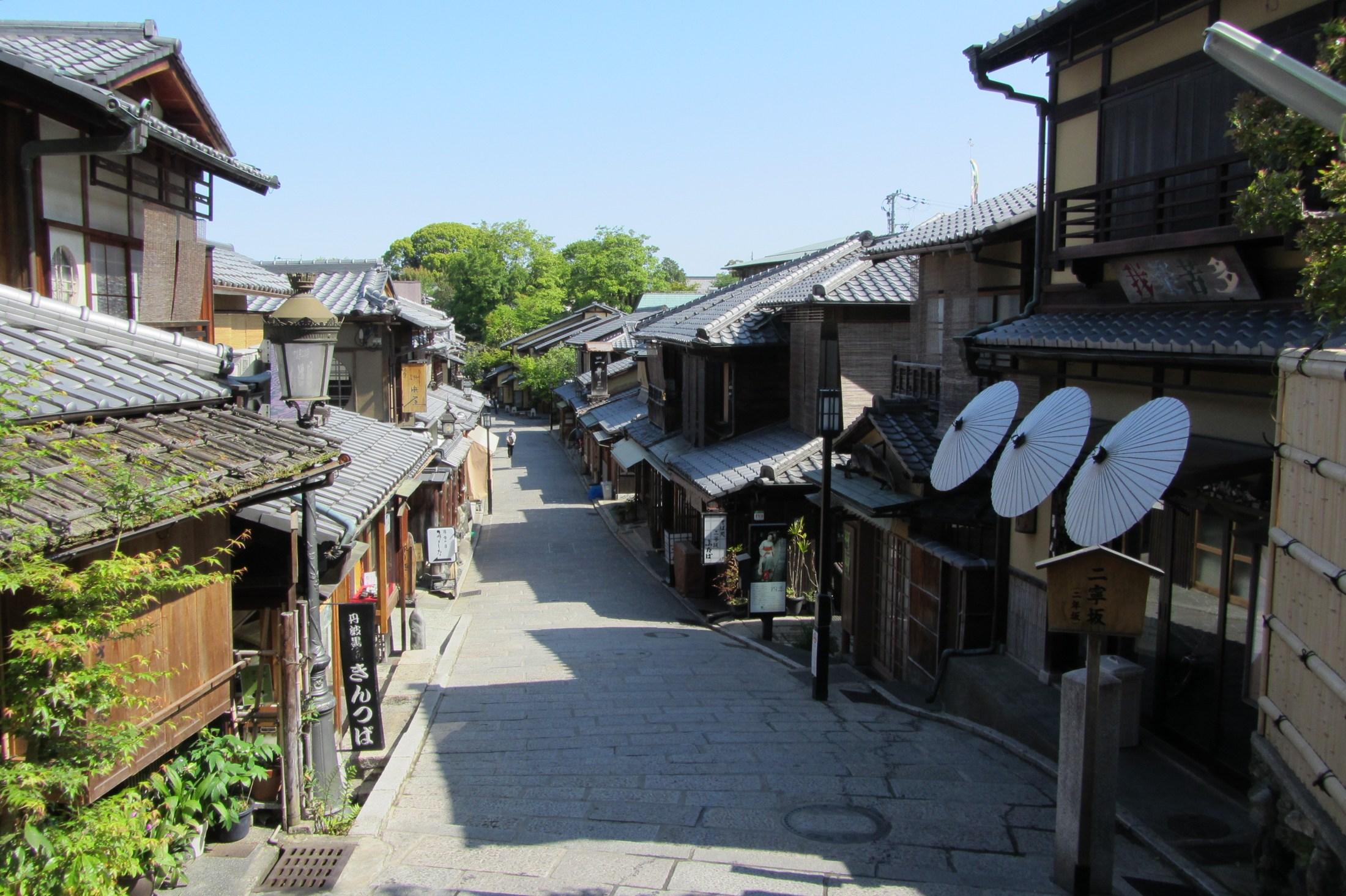
Ninenzaka in particular can feel almost impossibly busy in the middle of the day. The narrow street funnels people between shops and traditional wooden buildings, and at particularly busy times it can feel as though everyone in Kyoto has decided to walk the same route at once. My instinct, especially after having done it several times, was often just to get through it.
But that misses something important about the street.
Ninenzaka and neighboring Sannenzaka are part of an old network of roads that developed around the temples and shrines of eastern Kyoto. This was the route toward Kiyomizu-dera, and from the middle of the Edo period the streets increasingly developed around the people making that journey. The shops selling food, souvenirs and crafts today are not entirely a product of modern tourism. They are descendants of a much older culture of shops serving people making the rounds of the area's famous places.
The architecture is layered in much the same way. Along the slopes are machiya and other buildings dating from the late Edo period through the Meiji and Taishō eras. Ninenzaka's stone steps, the winding stone-paved streets, the wooden buildings, walls and greenery are now protected as part of the larger Sannenzaka Preservation District for Groups of Traditional Buildings, first designated in 1976.
In other words, people have been coming here for a very long time.
Realizing that changed the way I thought about the crowds a little. Ninenzaka was never really supposed to be an undiscovered corner of Kyoto. It grew in part because people came here. The procession of visitors between temples, shops and places to eat is itself part of the history of Higashiyama, even if there are rather more of us doing it today.
Still, that doesn't mean you have to spend your entire visit moving with the crowd.
After enough trips through Higashiyama, I learned that some of my favorite moments came from leaving the obvious route. Walk a street or two away from the main flow and things can change remarkably quickly. Follow a lane simply because you haven't walked down it before. Take the longer way between two places. Look for the smaller temple you noticed on the map rather than immediately moving on to the next famous one.
You don't have to go particularly far. Around Nene-no-Michi, for example, Kōdai-ji and Entoku-in give you a reason to step away from the procession toward Kiyomizu-dera. Kōdai-ji was founded by Nene in memory of her husband, Toyotomi Hideyoshi, while nearby Entoku-in is associated with the final years of her life. If Nene-no-Michi itself is packed, even moving one street east to Shimogawa-dori can give you another way through the neighborhood.
If you have more time, keep walking north. Shōren-in is one of my favorite examples of how quickly Higashiyama can change. It sits only a short distance from some of the district's busiest streets, but once inside you find gardens, moss, trees and a much quieter atmosphere. Chion-in and Maruyama Park are nearby too. None of this requires abandoning Higashiyama or skipping its famous sights. You're just expanding the area you're willing to explore.
Kyoto City's official tourism guide has a particularly good walking route through Higashiyama that connects Shōren-in, Chion-in, Maruyama Park, Kōdai-ji, Entoku-in, Ninenzaka, Sannenzaka and Kiyomizu-dera. It is worth using as a starting point rather than treating the most famous streets as the entire neighborhood.
And, if you really want Ninenzaka itself, come early.
Kyoto's own tourism guidance recommends visiting this part of Higashiyama in the early morning. Before the shops open and the day-trippers arrive, Ninenzaka and Sannenzaka become very different streets. You can actually see the buildings rather than the people in front of them, and the stone paving and old machiya become the focus again.
But I don't think the lesson is simply to wake up earlier.
One of the things I eventually came to appreciate about Kyoto is that you don't necessarily need to choose between seeing its famous places and escaping them. Higashiyama rewards a bit of wandering. See Kiyomizu-dera. Walk down Sannenzaka and Ninenzaka. Get the photograph of Yasaka Pagoda that everyone else wants.
Then turn off the main street.
Some of my favorite memories of this part of Kyoto are not of any particular attraction. They're of the moments when the crowd disappeared, when I found myself on a quiet residential lane or outside a small temple I hadn't planned to visit, knowing that one of Japan's busiest sightseeing districts was only a few minutes away.
There is value in seeing the places everyone comes to see. The trick is remembering that they aren't the only places worth looking.
Sources & Further Reading
- Kyoto City. “Sannenzaka Preservation District for Groups of Traditional Buildings.” Kyoto City. https://www.city.kyoto.lg.jp/tokei/page/0000281761.html.
- Kyoto City Official Travel Guide. “Higashiyama at Dawn: Kiyomizu-dera Temple to Yasaka-jinja Shrine and Gion.” Kyoto City Official Travel Guide. https://kyoto.travel/en/itineraries/higashiyama-at-dawn/.
- Kyoto City Official Travel Guide. “How to Avoid the Crowds While Accessing Kiyomizu Temple and Higashiyama Areas.” Kyoto City Official Travel Guide. https://kyoto.travel/en/travel-inspiration/how-to-avoid-the-crowds-while-accessing-kiyomizu-temple-and-higashiyama-areas/.
- Kyoto City Official Travel Guide. “Hōkan-ji Temple (Yasaka Pagoda).” Kyoto City Official Travel Guide. https://kyoto.travel/en/destinations/hokanji-templeyasaka-pagoda/.