Back to Kyoto

Kyoto / CITY GUIDE

The story of Kyoto

A pair of painted folding screens depicting life in and around Kyoto
Scenes in and around Kyoto (Rakuchū rakugai-zu), early 17th century. A pair of six-panel folding screens; ink and colour on gold paper. Source & collection

A capital laid out in a grid.

Kyoto’s history as an imperial capital began in 794, when Emperor Kanmu established Heian-kyō here. Inspired by Chinese capitals, its planned streets formed a grid across the basin. The imperial court remained in Kyoto for more than a thousand years, even when military governments exercised power elsewhere. The court’s move to Tokyo in 1869 marked a profound change in the city’s role.
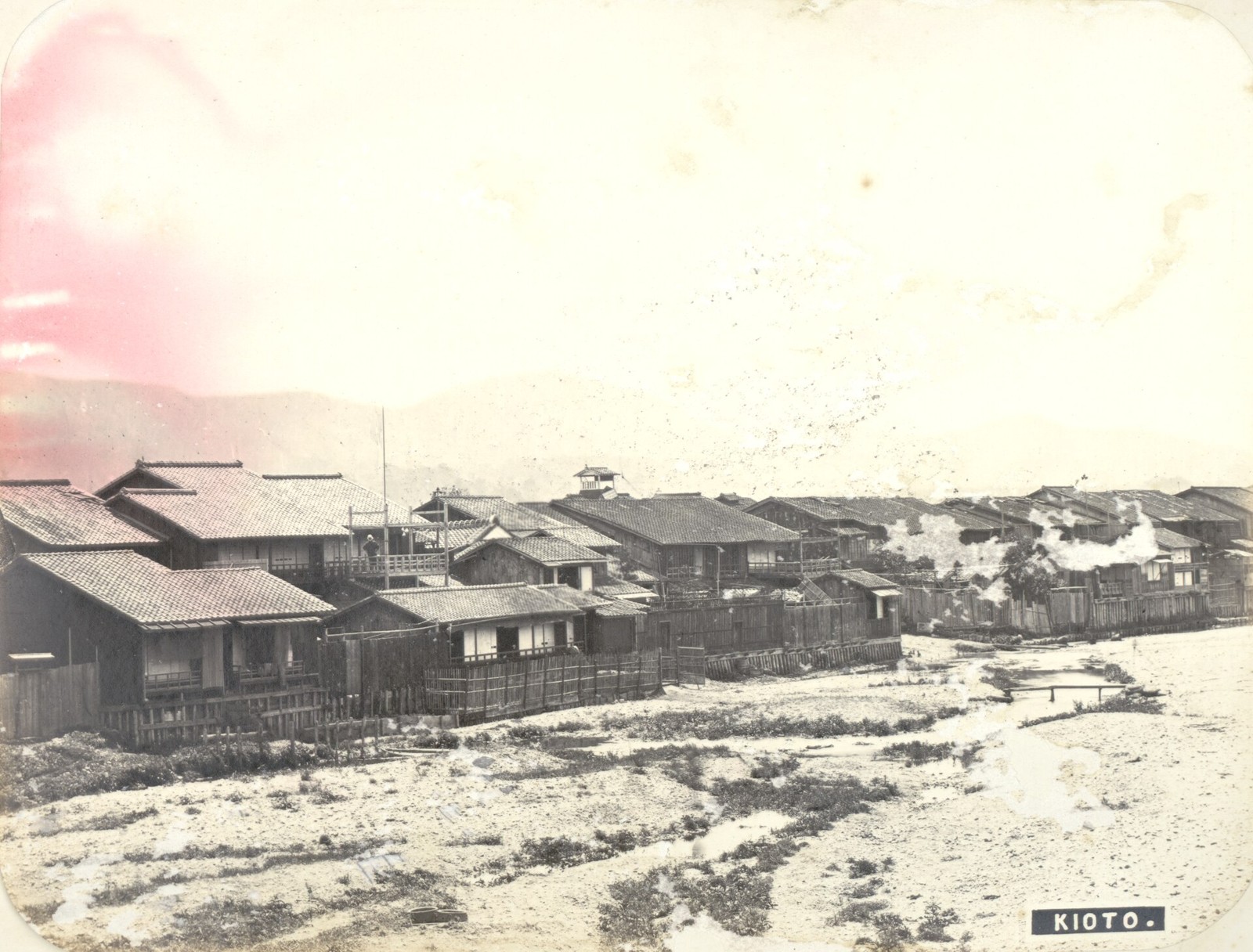
Early photograph of houses in Kyoto before 1880
Houses in Kyoto, before 1880. Photographer unknown; from the KITLV collection. Source & collection

A city made and remade.

The Kyoto you walk through is the result of centuries of rebuilding. Court culture, temples, merchants and craftspeople all shaped its neighbourhoods; wars and fires repeatedly changed them. After the capital moved, projects such as the Lake Biwa Canal and electric tramways helped Kyoto develop as a modern city. Its history includes workshops, universities and infrastructure alongside its famous gardens.

Hiroshige woodblock print showing Sanjo Bridge and Kyoto beyond
Utagawa Hiroshige, Kyoto, Sanjō Ōhashi, c. 1833–34. Kyoto at the western end of the Tōkaidō, imagined in a woodblock print. Source & collection

Reading the neighbourhoods.

The central street grid is a useful starting point, with the eastern hills beyond the Kamo River and different routes towards Arashiyama in the west. Historically, Kamigyō, the upper or northern city, developed around court and military institutions, while Shimogyō to the south had strong commercial and craft connections. These older identities do not map neatly onto today’s sightseeing areas. Our guides use practical groupings—Higashiyama, central Kyoto, the north, west and south—to help a day unfold at a walkable scale.

Find your own Kyoto.

Plan a journey